The inspection record nobody can find
you have to reconstruct it instead of producing it. Result: you argue about your diligence instead of showing it.

Digital maintenance lists, damage cases with photo and signature, rejection letters generated locally, chemical stock, consumption per vehicle and replies to your Google reviews — in one interface, on servers in Germany.
Facts
Daily backups · Two-factor authentication · Database and transport encryption
Starting point
A folder is cheap. It becomes expensive on the day someone needs something out of it: the customer, the assessor, the insurer, the safety inspector. What counts then is not that maintenance was done, but that it was documented with a date, a name and in a way you can find.
In practice that produces four cost items that appear in no calculation.
you have to reconstruct it instead of producing it. Result: you argue about your diligence instead of showing it.
A customer reports a scratch the next day. The case is noted on a scrap of paper, the photo is on a member of staff's phone, the signature is missing, and four weeks later nobody remembers who handled it. Result: you pay a goodwill amount, because collecting the pieces would take more effort than the damage.
Consumption is recorded nowhere, ordering went on instinct. Now a product is missing mid-operation. Result: an emergency order, or a wash programme running with a product missing.
Electricity and water run alongside, and the supplier measures once a year. A creeping increase in consumption is only noticed when it is twelve months old. Result: you discover the leak or the malfunction once it has already been paid for.
None of these points is dramatic. Together they are the reason why evenings go on paperwork in many businesses — and why nobody can say exactly what a wash costs in chemicals, electricity and water.
Process
Four modules record, one data pool in Germany — producing analyses per vehicle and the documents you would otherwise type. What is ticked off or booked on the tablet appears in the dashboard with no step in between.
The highlighted connections are the two that save the most in daily operation: meter readings from the maintenance list and consumption bookings from stock become the metric per vehicle without any transfer.
Tick off maintenance points, record damage cases with photos, registration document and signature, book chemical consumption — on the devices that are already there. Which ones those are is shown in the next section.
All entries end up in one database at Hetzner. Personal data — name, address, number plate — sits on a separate interface, not in the same data set as your operational data. Encrypted in the database, encrypted on the way there, backed up daily.
The recorded data produces metrics per vehicle and the documents you would otherwise type: the maintenance record and the damage case file as PDF, the rejection letter as a Word file, the order list as CSV. The rejection letter is written by a self-hosted language model in Germany, without access to the internet — you read the draft, change it, approve it.
Recording
The platform does not depend on your wash control system and needs no new infrastructure. Five routes lead into the same data pool — each where the work happens.
In the office or plant room, PIN-protected. Shows only the list to be ticked off — no login, no searching.
Maintenance lists · Damage claims
Mobile app with its own account and its own notifications — service cases and approvals on the move.
Service · Notifications
Dashboard, analyses, orders, roles and permissions — you open the analysis wherever you sit.
All modules
The customer enters the damage claim themselves — without access to your data. The confirmation of receipt goes out automatically by email.
Damage claims
Book consumption and goods receipt without typing — stock updates with the scan.
Chemicals & stock
All six modules point by point — with roles and permissions for multiple sites.
Reviews module
The module connects the platform to the Google Business Profile of your car wash. You read, classify and answer reviews in the same place as your maintenance and damage cases.
Your reviews on Google arrive in one inbox. The platform classifies them by topic, such as wash result, drying or vehicle damage, suggests a reply and publishes your reply on Google once you have approved it. Automatic replies only run if you explicitly switch them on, and never for reviews that allege vehicle damage. The draft replies are written by a self-hosted language model, without any external AI provider.
When connecting, you sign in with Google and allow the application “Flowcontrol - Cloud-Platform” to manage your Business Profile. This is the only way to read reviews and publish replies. The platform reads the reviews of the locations you map (reviewer’s display name, rating, text, date, existing reply) and publishes your replies. It changes no other profile data. The data is stored encrypted in Germany and serves only these functions, not advertising and not the training of AI models. How we store, share and delete it is set out in our privacy policy, section 10.
Google and Google Business Profile are trademarks of Google LLC. Flowcontrol by Florian Hofmann is not a partner of Google and is not sponsored by Google.
Insights
The screenshots below come from the platform itself. The content is a test data set.
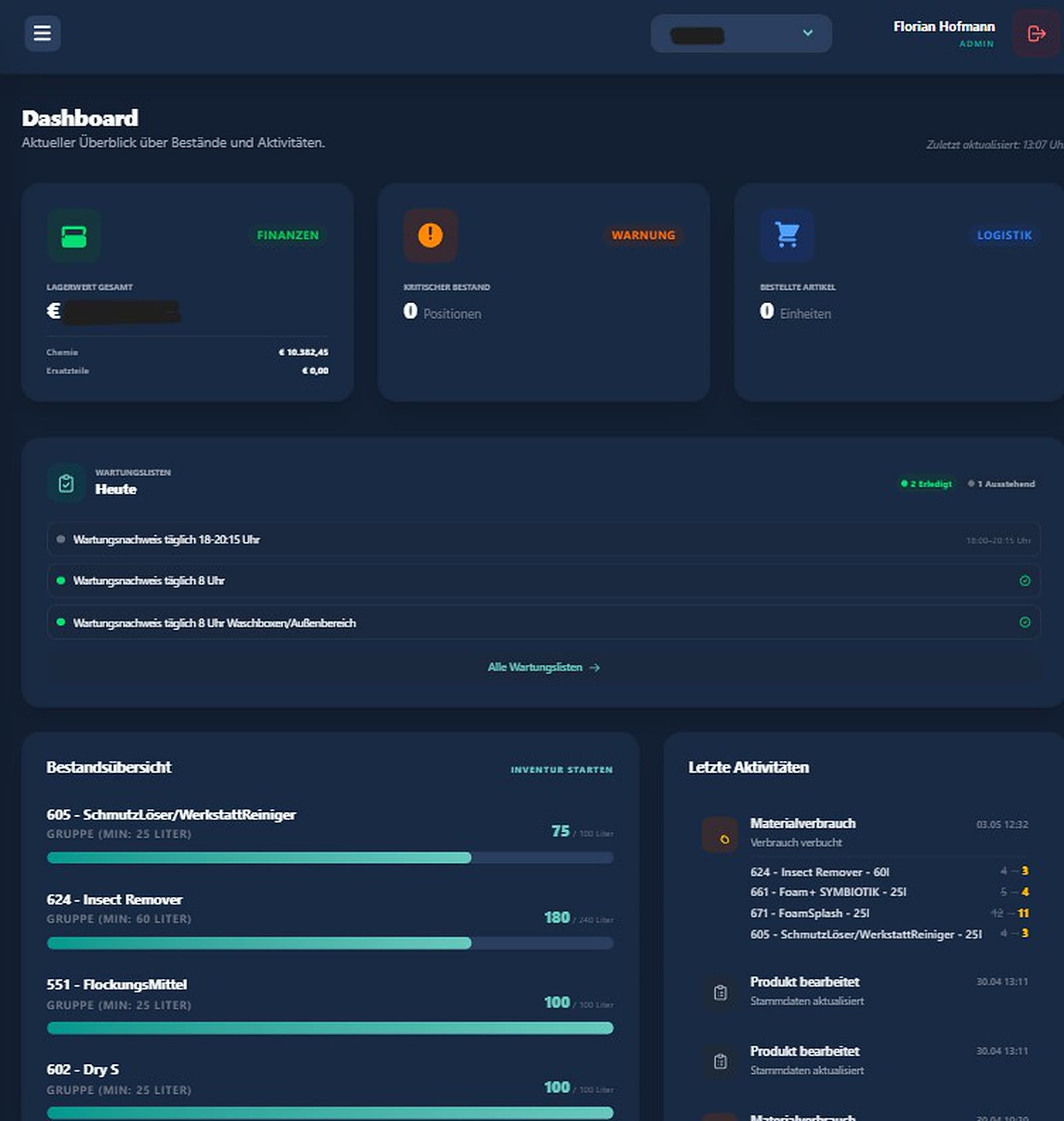
At the top the stock value and the number of critical items, below that the maintenance lists due today with their progress, and at the bottom the stock levels with their stored minimums and the most recent entries.
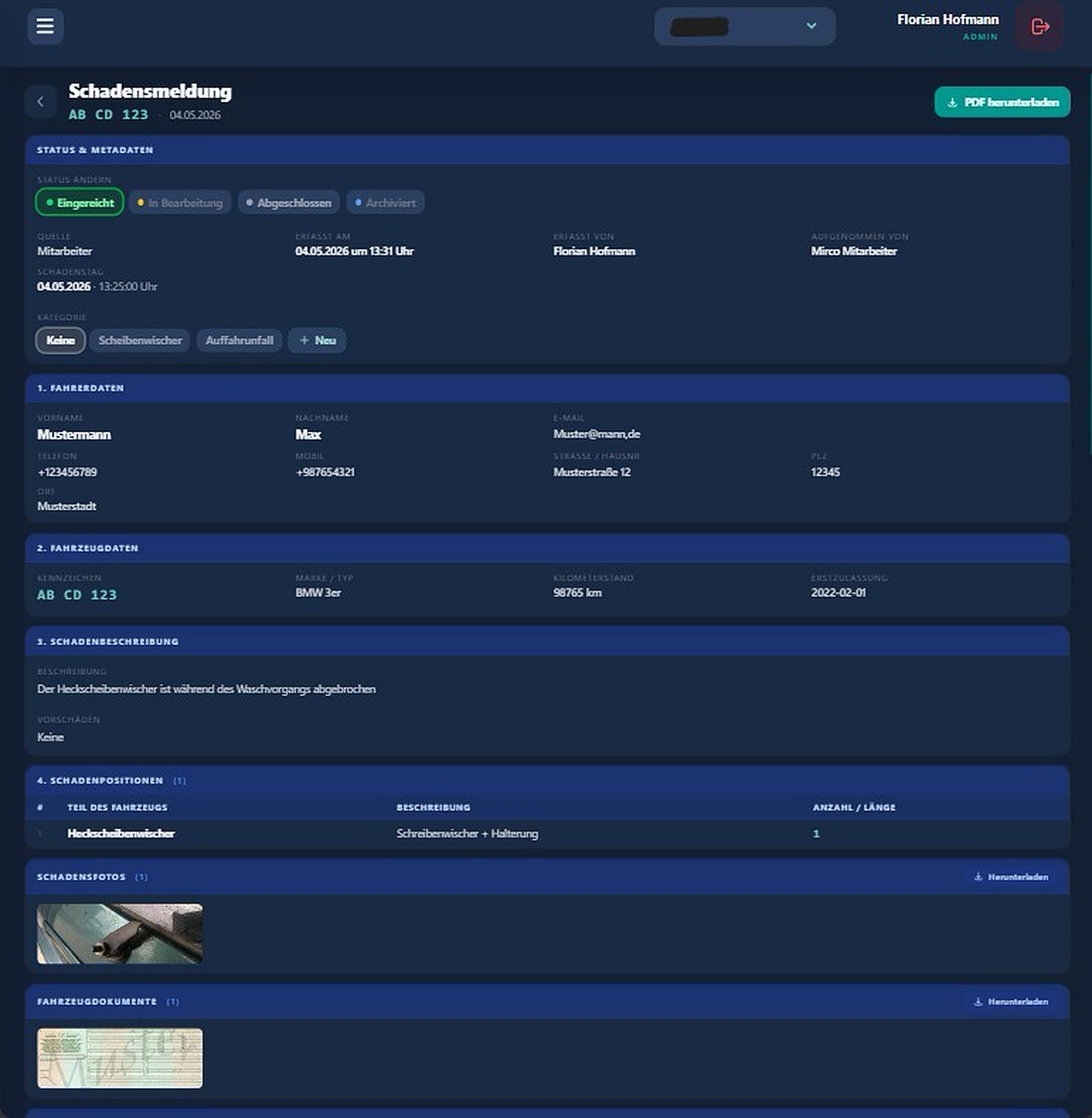
Status and timestamp, who recorded the case, driver and vehicle details, the damage items individually, plus the damage photo and the registration document. The PDF is generated from the same view.
The same damage case file, further down: from the recorded details, a self-hosted language model in Germany generates the draft rejection letter. You read it, change it, approve it — as a Word file.
Benefits
Every inspection point ticked off gets a time, a name and a record. If a question comes in — from the insurer, from an assessor, from an inspection — you download a PDF instead of searching a folder.
Photo, registration document, damage items and signature are created in the same case, on the tablet or via the customer's QR link. You enter the discussion with evidence rather than with a recollection.
The draft comes out of the case file, not out of a template someone fills fields into. You check it, cut it down, approve it. What you save is not the reading — it is the drafting.
You enter meter readings and prices each month; the platform breaks electricity, water and freely defined metrics down to the wash count and flags outliers. A creeping increase is noticed within the month, not in the annual bill.
Scope
Is this the right system for you? The platform is right for you if maintenance records, damage cases, chemical stock and consumption figures currently live on paper, in Excel and in one person's head. It is the layer on which cases are managed — it does not produce evidence itself. If what you are missing first is the image of the condition on entry, vehicle documentation comes first. If vehicles run into each other in the tunnel, vehicle tracking comes first. Both then end up here. And what each of the six modules contains in detail is shown in the complete feature overview.
Calculation
We do not know your business, so we do not put industry values in either. Three sliders describe your business, three describe how much work digital recording actually takes off your hands. Those three we deliberately do not preset — we have no reliable measurement for them, and an invented figure would devalue this page.
Important limitation. The calculator shows working time freed up, not additional revenue. Hours saved only become money if they are used for something else or not paid. Use the hourly rate the work actually costs today.
You set the following three values yourself. We do not preset an industry value here.
working time freed up per year
What the calculator does not show: the damage claim you reject with a photo and a signature instead of paying goodwill. The chemical stock that is not empty on Saturday. The increase in consumption noticed within the month rather than in the annual bill. These items are real, but we cannot put credible figures on them for your business — which is why they are not in the calculation.
The calculator values your working time, not the goodwill payment avoided — that is on the page for vehicle documentation. Adding the two results together would be double counting.
Pricing model
Quoting a blanket range would not be credible for the platform: whether you run one site with two modules or four sites with all six makes the difference. What we set out instead is how the quote is built up — so that you know what to ask about in the conversation.
Your own data set, user accounts with roles and permissions, two-factor authentication, operation on the servers in Germany, daily backups and ongoing software updates. Nothing runs without this package.
Maintenance lists, damage claims including the AI rejection letter, service, chemical and stock management, consumption analysis per vehicle, reviews — six modules. You take what you need and add later. Adding a module is an activation, not a new project. What each module contains is shown in the feature overview.
We take your inspection points, wash types, chemicals and minimum stock levels and set them up. That is the part that makes the platform your platform — and the part where the effort varies most.
A tablet in PIN-protected kiosk mode for the hall, with a SIM card if you want one.
Briefing your staff on site, on the devices they will be working with afterwards.
Does this fit?
The platform does not depend on your wash controller. It does not intervene in the tunnel, it stops nothing and it needs no approval from your wash manufacturer. It sits at the level above: where things are documented, ordered and analysed.
| Step | When |
|---|---|
| Initial call — which modules, how many sites, which devices | free of charge |
| Recording your inspection points, wash types and chemicals | one appointment with your contact |
| Setup and configuration by us | depending on scope |
| Training on site, on the devices that will be used afterwards | before go-live |
| Live operation. The monthly amount starts here | after acceptance |
Data sovereignty
Hosting in Nuremberg and Falkenstein. Personal data is kept separately on its own interface, not in the same data set as your operational data. Only login, email delivery and push notifications run via Google; this may involve a transfer to the USA.
We run open-source language models ourselves, on computers in Germany. They have no access to the internet and generate the text locally — no request goes to an external AI provider.
Database encryption using AES-CBC, TLS for every connection, two-factor authentication and role assignment per account. Daily backups.
We provide the data processing agreement, the data protection impact assessment and the documentation of technical and organisational measures before you sign — not on request.
This website too. You see no cookie banner here, because there is nothing to consent to: we use no trackers.
Critical questions
The scope and form of a full handover at the end of the contract are set out in the contract; raise it in the initial call and it will be in the quote.
The application buffers connection failures — what has been recorded is not lost and is transferred as soon as the connection is back. Even so: the platform is a cloud application. In a longer outage you cannot reach the analyses and history, and we would rather say so in advance. For the hall, the tablet is 5G-capable and can be fitted with a SIM card so that it does not depend on Wi-Fi.
The letter is a draft, not a decision. It is generated from the details in the case file and only goes out once you have read it, changed it and approved it — responsibility for the content stays with you, as it does for every letter your business sends. We do not claim that a language model replaces legal advice, and in a contested situation the case belongs with your solicitor or your insurer. What the platform takes off your hands is drafting the standard case, not the legal assessment of the exception.
That is the most common reason digitisation projects run into the sand, and it depends less on the software than on whether the new route is shorter than the old one. That is why the tablet sits in kiosk mode where the work happens and shows only the list to be ticked off — no login, no menus, no searching. What we cannot take off your hands: the decision that from a given date the paper list no longer counts. Without that announcement both routes run in parallel, and that is worse than before.
Master data, yes: chemical lists, inspection schedules, minimum stock levels and users we take over from whatever you have — a spreadsheet, a text document or a printout. Historic damage cases from a third-party system are a separate cost item, and we tell you openly beforehand whether it is worth it. In many cases the honest answer is: archive the old cases in the old system and make a clean start with the platform.
From you. You enter the electricity and water meter readings monthly and store the price per unit; the wash counts come from your own records. From that the platform calculates consumption per vehicle and flags outliers. There is no automatic meter reading — that is the honest part of the answer. The effort is a few minutes a month, but it falls to you, and if nobody enters the figures there is no analysis either.
The main database and the separate interface for personal data run on Hetzner servers in Germany, in Nuremberg and Falkenstein. Only login, email delivery and push notifications run via Google; this may involve a transfer to the USA. We run the language models for rejection letters and draft replies ourselves in Germany, without internet access. You receive the data processing agreement, the data protection impact assessment and the documentation of technical and organisational measures before the contract is signed.
Before you call: the feature overview shows point by point what each module includes.
Other systems
A damage case file is most often missing the same thing: the documented condition of the vehicle before it drove into the system.
Price range after an initial call →If you want to analyse a metric that exists in no module, or you have to connect an existing system: the platform is usually the base such things are built on — user management, roles and export are already in place there.
Price range after an initial call →The platform documents the damage claim. The vehicle tracking starts one step earlier and intervenes in the tunnel before it becomes damage .
Next step
For a solid estimate we do not need a meeting on site. Have these two points ready and the rest becomes clear on the phone.
You speak directly to the developer and owner, not to a call centre. If one module is enough for your business, we will tell you that — instead of selling you six.
Available Monday to Friday, 9am–4pm · info@flowcontrol.de